On this page
Thin arms, a soft belly, a weight that looks normal on the scale, and one question that never gets a straight answer: cut or bulk? Without a straight answer, it is easy to restart the gym every few months, or to crash diet and lose muscle you worked for.
"Skinny fat" is a gym word, not a diagnosis. On this page it means thin arms and a soft belly at a BMI under 25. You need a tailor's tape, a scale and two numbers: your waist and your BMI. They pick where you start. They do not grade your body.
Who should stop before measuring?
Check these first. Any yes: pause, and see a doctor (a physio for a joint) first. Once they clear you, carry on, within their limits.
- You are under 18. This test is for adults.
- You are over 60. This test is not built for you: doctor first, then a coach.
- You are pregnant, breastfeeding, or gave birth under 6 months ago. The food settings below are not for you, even once cleared.
- You are trying for a baby. Doctor first. No eating less, and ask about folic acid.
- You lost over 5 kg, or 5 percent of your weight, in 6 months without planning to, or you have night sweats, fever, a cough over 3 weeks, or very high thirst or urination.
- Chest pain at rest or in activity, fainting in activity, dizziness that made you lose balance in the last 12 months, or unusual breathlessness.
- A heart condition, high BP or another long-term condition (sugar, thyroid, PCOS, asthma, kidney), or medicine prescribed for one.
- A bone, joint, muscle, ligament or tendon problem that activity could make worse, or you were told to exercise only under medical supervision.
- You use steroids.
Food and body image come first too. If you make yourself sick, use laxatives to control your weight, fear eating, or have had an eating disorder, please skip the measuring and the food changes, and talk to a doctor or a psychologist who does this work every day. Free, any hour: Tele-MANAS, 14416. The free card below has a five-question check for this. And if measuring your body upsets you today, that is reason enough to skip it. Nothing here is urgent.
How do you measure your waist at home?
Height: shoes off, heels against a wall, standing tall, looking straight ahead. Lay a book flat on your head, mark the wall under it, and measure from the floor to the mark in cm.
Weight: in the morning, after the toilet, before food, on the same scale. If you land within 1 kg of a line in the next section, weigh on 3 mornings this week and use the average. Weight moves day to day with water, salt and food.
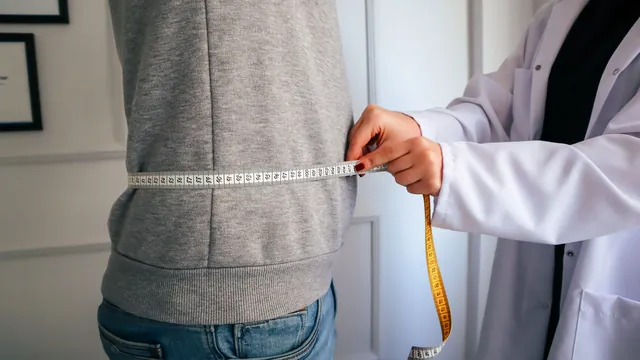
Waist:
- Stand with your feet together, shoulders relaxed, tape on bare skin. Morning, before food, is best.
- Press in at your side for your lowest rib, then slide down to the top of your hip bone. Pen a dot on each, then one halfway. It usually lands just above the belly button.
- Wrap the tape level all the way round over the dot, touching but not tight. Check the back in a mirror.
- Breathe out normally, belly relaxed, and read the cm side without bending to read it.
- Do it twice. Within 1 cm? Use the average. If not, measure again.
Why not at the belly button? WHO and NICE (UK) both measure halfway between the rib and the hip bone, and different spots give different readings. Whichever spot you have used before, use the same spot every time from now on.
Your two numbers: BMI and your waist line
BMI is your weight in kg, divided by your height in metres, divided by your height in metres again. Near a line, do not round up: 24.98 is under 25.
Your waist line is half your height, but never over 90 cm for men or 80 cm for women.
Take a man who is 172 cm, 70 kg, with an 88 cm waist. His BMI is 70 ÷ 1.72 ÷ 1.72 = 23.7. Half his height is 86, which is under 90, so his line is 86. His waist of 88 is over the line. A woman who is 165 cm has a half-height of 82.5, which is over 80, so her line is 80.
If your waist is within 1 cm of your line, measure on 3 mornings before you decide.
Where the lines come from: UK health guidance (NICE) says keep your waist under half your height. A 2009 consensus of Indian experts, kept in their 2025 update, sets 90 cm for men and 80 cm for women. These lines flag where health risk tends to rise in groups. They are not a rule for how you should look.
Cut or bulk? Find your path
Check in this order and stop at the first one that fits:
- BMI under 17: stop. See a doctor before you change your food or training.
- BMI 17 to under 18.5: do not lose weight. Tired, dizzy, always cold, losing hair, or periods stopped? Doctor first. Waist at or over your line as well? Measure again, then ask a doctor. Otherwise Path B, with its BMI under 18.5 setting.
- BMI 25 and over: Path C.
- BMI under 25, waist at or over your line: Path A, recomp.
- BMI under 25, waist under your line: Path B, lean gain.
So is it skinny fat or not? Path A is the setting gyms usually mean by the word: a starting point, not a verdict. Path B is not, by the tape. If you still feel soft, a year of training can change your shape a lot. Path C is a different question.
Path A: recomp, neither a cut nor a bulk
Recomp means losing fat and building muscle at about the same weight. Beginners can do both when food stays close to maintenance, the amount that keeps your weekly average weight flat.
- BMI under 23: maintenance only. Do not eat less.
- BMI 23 to under 25: eat as you do now (maintenance). Waist flat at two tapes, or waist and lifts flat at one? Add 2,000 steps a day first. Flat at the next tape too? Eat up to about 200 to 300 calories a day less (smaller women, nearer 200). For scale, that is about 2 tablespoons of ghee or oil. If you use less than that, or someone else cooks, trim snacks, sweets or the sugar in your chai, never protein.
- Eating less, and your periods stop for 2 months, you are always cold, or your hair falls? Go back to maintenance, and see a doctor.
The scale may barely move on Path A. That can be fine. Watch your waist and your lifts.
Path B: lean gain, a small bulk
You do not need to cut. A little extra food builds muscle; a lot mostly adds fat.
- Food: what you eat now, plus one add-on a day: a 200 ml glass of whole cow's milk (about 146 calories) or 30 g of peanuts, a small handful (about 156 calories). For most people that is about 5 to 10 percent over maintenance.
- BMI under 18.5: 10 to 15 percent over. Men, have both add-ons. Women, start with one.
- Weeks 1 and 2: a jump on the scale is mostly water and food. Judge from week 3.
- Weekly average no higher than 2 weeks ago? Add one more add-on (150 to 250 calories a day).
- Up more than 0.5 percent of your weight a week (0.3 kg at 60 kg)? Drop an add-on.
- Waist reaches your line? Stop adding food and move to Path A.
Path C: BMI 25 and over
You did nothing wrong. At BMI 25 and over, how much to eat, walk and lift should be set around you, so this page has no fat-loss plan for you. Our Plan Only is ₹799 once: a 30-day workout program built around your goal and equipment, with no food guidance and no check-ins. Pro is ₹1,499 a month: the program, food guidance, daily WhatsApp check-ins and a weekly review with your coach. Both start with a short health check, then a coach builds it.
Not ready to pay? Build toward 7,000 to 8,000 steps a day and start our free gym starter plan or home starter plan.
How do you find maintenance without a calculator?
Skip calorie calculators. India's ICMR says the international FAO/WHO/UNU equations can run 10 to 12 percent high for Indians at rest. Your own scale is a better guide:
- Weigh yourself on 3 or more mornings a week, take the average, and compare week with week, never day with day. Women: water peaks on day 1 of your period, so ignore that week or compare with the same week last cycle.
- End any diet and eat normally, weekends too. Just finished a diet? Add 2 weeks first: mostly water.
- Started lifting too? Eat the same through week 3, because weeks 1 and 2 bring water. Then compare week 3 with week 2.
- Within 0.5 kg? That is your maintenance. Up by more? Take one thing away. Down by more? Add one back.
On Path B, start the add-on from day 1 and skip this check: judge from week 3 by the Path B rules.
How should you train on Path A or Path B?
- Protein: 1.6 g per kg you weigh each day. Vegetarians who train, 1.8 to 2.0 g. Our guide to how much protein you need has the Indian food sources.
- Path A: lift 3 to 4 days a week, adding reps and then weight (progressive overload). Your cardio is just your steps.
- Path B: full body or upper and lower, on the days you truly have, adding reps and then weight (full body or split?).
- Steps: build toward 7,000 to 8,000 a day, adding about 2,000 at a time. On Path B, a daily walk is enough.
- Sleep: 7 hours or more.
- No crash diet. In one review of lifting trials, eating about 500 calories a day less stopped muscle gain on average.
Warning signs: chest pain or pressure, or dizziness or breathlessness out of proportion to the effort. Stop training and see a doctor today, or go to the nearest hospital emergency department. For chest pain or pressure, call 112 (India's emergency number) or go now.
When should you measure again?
Tape and test once every 4 weeks, same spot, same time of day. A new health problem? The stop list at the top wins. Otherwise stay on your path until a switch rule says move:
- Path A to Path B: your waist is under your line, and your main lifts have gained no reps or weight for 4 weeks at maintenance. If you were eating less, go back to maintenance first. Lifts still rising? Stay on A.
- Path B to Path A: your waist reaches your line.
Get the free Tape Test card
The free card puts this on 15 phone screens: the safety questions, the waist steps, a height and weight table so you need no calculator, the three paths and your next 4 weeks. It is free on Gumroad, which asks for your email and sends the file: Skinny Fat or Not? The Tape Test. Send it to the friend who keeps asking "cut or bulk?"
Our 12-week guide is out now: Skinny Fat to Strong, ₹699 once, for adults on Path A or B (BMI under 25), men and women, with Gym and Home editions. It is a guide, not a plan built for your body, and it is self-run: no coach replies or check-ins. Stopped by a stop question, on Path C, over 60, pregnant or breastfeeding? It is not for you. Injuries or conditions: doctor first. Prefer WhatsApp? Send RECOMP to us on WhatsApp for the link.
Frequently asked questions
Is skinny fat a medical condition?
No. It is a gym word, not a diagnosis. On this page it means thin arms and a soft belly at a BMI under 25. Your waist and your BMI pick a starting setting for food and training. They do not grade your body.
Should I cut or bulk with thin arms and a soft belly?
If your BMI is under 25 and your waist is at or over your line (half your height, never over 90 cm for men or 80 cm for women), start with a recomp at maintenance. If your waist is under your line, eat a little extra for a lean gain. Neither path starts with a hard cut.
Can you lose fat and build muscle at the same time?
Beginners can, when food stays close to maintenance. That is a recomp. The scale may barely move, so watch your waist and your lifts instead.
Where exactly do I measure my waist?
Halfway between your lowest rib and the top of your hip bone, after a normal breath out, tape level and touching but not tight. WHO and NICE both measure there. It usually lands just above the belly button. Use the same spot every time.
How often should I measure my waist?
Once every 4 weeks, same spot, same time of day. Weigh yourself on 3 or more mornings a week and compare weekly averages, never day with day.
My BMI is 25 or over. What now?
This test stops there for you, because food, walking and lifting should be set around you. See our Plan Only and Pro plans, or start with steps and a free starter plan.
Is the Tape Test card free?
Yes. It is ₹0 on Gumroad, which asks for your email and sends you the phone PDF.
General education, not medical advice. With an injury, a medical condition or in pregnancy, your doctor's or physio's advice wins over this page.